Runeasi: real-time running biomechanics
Business context
Runeasi is a KU Leuven spin-off specialising in wearable technology. The application developed by Leaware is the result of an eight-year collaboration between the Human Movement and Artificial Intelligence Research Groups at KU Leuven, combining scientific expertise with clinical practice. The goal was to provide objective, immediate feedback on movement quality in order to quickly identify weak links and technical errors in runners and patients.
The market was dominated by costly, stationary 3D laboratories, which limited access to advanced biomechanical analysis. Runeasi wanted to close this gap by using wearable sensors and AI to deliver personalised biomechanical insights both in the clinic and in the field. A key advantage was the placement of the sensor in the sacral area, making it possible to capture the overall impact of loads on the body.
The project's strategic objective was to demonstrate that it is possible to create an innovative, scalable application combining wearables and AI that addresses real healthcare and sports needs while maintaining high measurement reliability and ease of use.
Challenge
The biggest challenge was translating data from wearable sensors into reliable, clinically useful indicators without the support of an expensive 3D laboratory. This required designing AI algorithms to analyse running patterns and asymmetries in real time, while ensuring stable data streaming and visualisation on a mobile device.
It was equally important to create a user experience that engages the patient and makes it easier to optimise technique independently through immediate visual feedback and gamification elements. A consistent taxonomy and tagging system was also needed to organise studies by injury type, athlete profile, test protocol or surface, and to compare results over time.
The operational context required the solution to work across different environments: from the consulting room to the treadmill and the stadium. The system had to support straightforward workflows for medical staff, combine biomechanical data with the patient's subjective assessment of exertion, and fit into rehabilitation and return-to-sport practice, including through educational content for professional users.
Solution
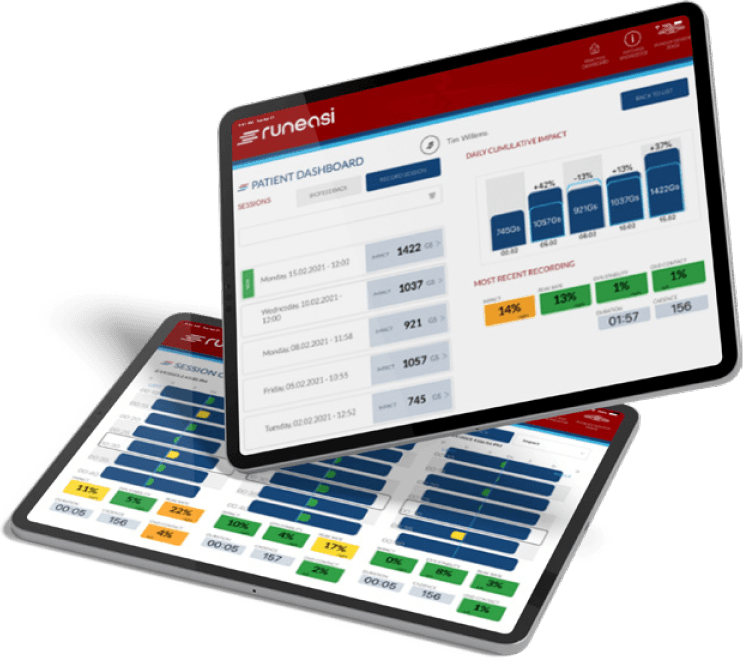
Leaware developed the Runeasi application, which integrates a sacral sensor with AI algorithms to capture and analyse total loading and running patterns. The system detects asymmetries and weak links in real time, while clear visualisations provide objective feedback both in clinical settings and in the field, supporting therapeutic and coaching decisions.
The user experience was enhanced with gamification to increase engagement and make self-improvement easier in line with clinical recommendations. The application makes it possible to build an individual biomechanical "blueprint", establish baseline values and track progress in the return-to-play process, linking results with strength, mobility and functional tests. The patient can assess subjective exertion, complementing metrics not traditionally measured, such as heart rate, speed or distance.
To streamline the work of professionals, a catalogue of predefined tags was prepared, along with the option to create custom ones based on injury type, athlete profile, assessment protocol or surface. The solution supports service delivery in any location, and the early rollout was met with a positive response — first users highlighted the efficiency of patient screening and the valuable insights generated by the analysis.
“Leaware was very transparent and honest when it came to budget matters.”