Monkey Run – Banana Chase: a multi-screen game
Business context
As a digital product studio, Leaware wanted to clearly demonstrate its capabilities in building engaging applications using modern technologies. In 2015, the company launched the Monkey Run – Banana Chase game project to showcase the practical use of cross-platform tools and real-time architectures in the gaming industry.
The market was seeing growing demand for multi-device and multiplayer experiences that combined mobile interfaces with larger screens. Monkey Run – Banana Chase was created as a demonstrator of this approach: mobile devices connect to the server, while the gameplay is displayed on a large screen, combining entertainment with technology.
The project aligned with Leaware’s business objective: to strengthen its image as an innovator, build expertise in real-time data synchronisation, and show clients how technology can increase user engagement.
Challenge
The key challenge was to achieve seamless real-time synchronisation between multiple mobile devices and the server, so that the gameplay displayed on the large screen accurately reflected players’ actions. This required low latency, stable communication, and immediate interface responsiveness.
It was essential to design reliable network communication for changing connectivity conditions, manage game sessions and state consistency, and minimise the risk of desynchronisation. At the same time, the team needed to ensure an easily scalable backend and smooth gameplay with a larger number of concurrent participants.
An additional layer of complexity came from cross-platform delivery: iOS, Android, Windows Phone, Apple Watch, and various Smartwatches. Differences in hardware capabilities, interaction models, resolutions, and power constraints required a consistent UX approach and efficient use of resources.
Solution
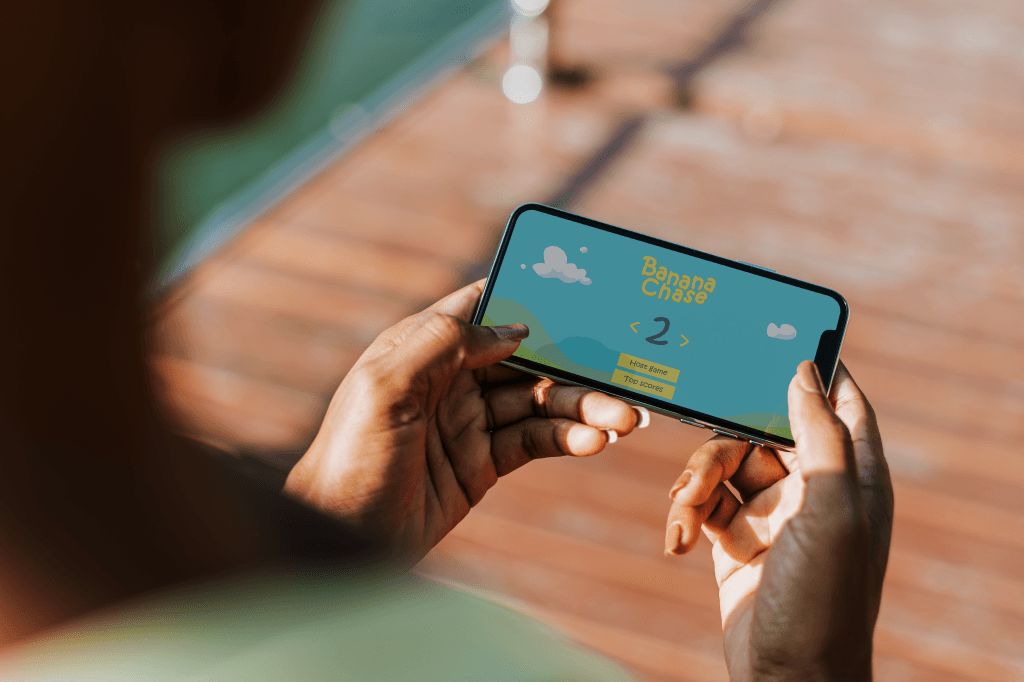
Leaware chose Xamarin as the technology foundation, which made it possible to build a single cross-platform application and deliver it to iOS, Android, Windows Phone, Apple Watch, and various Smartwatches. This approach reduced development time, simplified maintenance, and ensured functional consistency across multiple devices.
The gameplay architecture was based on communication between mobile devices and a web server, which orchestrates the session and presents the course of the game on a larger screen. The devices act as controllers, while the server consolidates events in real time to ensure a unified experience visible to all participants.
The team implemented real-time synchronisation mechanisms, optimised data packets and update frequency, and also ensured resilience to connection loss. Iterative user testing helped refine responsiveness, interface clarity, and animation smoothness across different device classes.
As a result, a scalable, easy-to-maintain foundation was created for multi-device experiences, combining engaging gameplay with mature technology and enabling further expansion into additional multi-screen scenarios.
Key metrics
85%+ "Excellent" ratings
Synchronisation feature rating (UX study after 6 months)
High user satisfaction with the multi-device gameplay
Shortlisted in several digital innovation competitions
Industry recognition
Validation of the solution’s innovation
iOS, Android, Windows Phone, Apple Watch, Smartwatches (5+)
Supported platforms
One codebase for multiple devices