No-code and MVP: opportunity or risk for startups?
How no-code accelerates MVP development and where the pitfalls lie: limitations, lock-in and scalability. Find out when it is worth using, when to choose your own stack instead, and practical ways to reduce the risk.
Tomasz Soroka
The new no-code reality
The startup ecosystem is growing rapidly – more than 130,000 new companies are launched every year. At the same time, no-code and low-code have matured, changing the way MVPs are built. According to Forrester, around 2018 roughly 23% of companies were using these tools, rising to 37% by 2020. In 2022 alone, low-code platforms generated revenue of $21.2 billion, confirming the scale of the trend.
Gartner describes no-code and low-code as building applications through graphical interfaces and configuration instead of traditional programming. For startups, this means a shorter path to MVP, faster user testing and a lower barrier to entry.
What are we talking about?
A startup is a young company looking for a scalable model through an innovative product. An MVP is an early version of a product containing only the core features needed to test assumptions in the market. No-code and low-code are sets of tools that make it possible to assemble such an MVP without programming knowledge, or with only minimal coding skills.
The tempting speed

For teams with limited budget and time, no-code is a shortcut to results. It creates an advantage in the Build–Measure–Learn loop and makes it possible to respond to customer feedback more quickly. According to Markets and Markets, the low-code market could grow to $45.5 billion by 2025, suggesting this is a lasting trend.
- Shorter time-to-market and earlier validation of hypotheses - Lower initial costs and reduced sunk cost risk - Faster iterations thanks to visual editors and ready-made integrations - The ability to work without a full development team at the outset
Hidden costs and risks
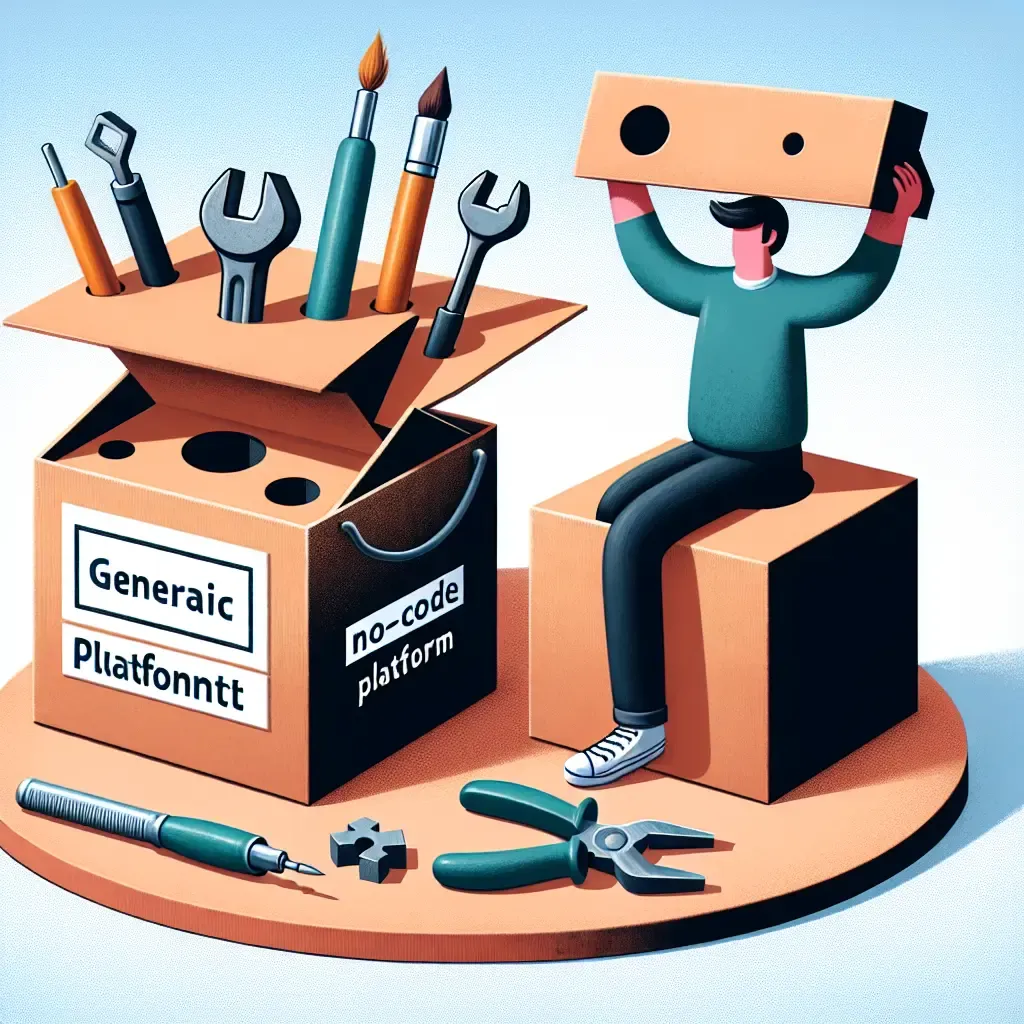
No-code is not a universal solution. Predefined templates, widgets and ready-made flows accelerate the start, but they limit flexibility when it comes to deep customisation or complex domain logic. CIO Magazine points out that this scope of freedom is often a barrier for growing products.
Another issue is the lack of key features. When the platform does not offer something, you are dependent on the vendor’s roadmap. Zion Market Research indicates that 37.2% of developers face functional limitations in no-code tools.
Another risk is lock-in. Once a product has grown within a specific platform ecosystem, migration or extension with your own code becomes difficult and expensive. Forrester warns that technological lock-ins are one of the ‘horsemen of the apocalypse’ in software.
- Limited flexibility and customisation for advanced use cases - Dependence on the vendor’s pace of feature development - Lock-in that makes migration and cost negotiations more difficult
Scalability and the long-term perspective
What works brilliantly for a prototype may slow down growth at scale. Growing data volumes, complex permissions, testability or compliance requirements often go beyond the one-size-fits-all model.
- Scalability and performance: platform architecture limitations can drive up response times and costs - Integrations and testing: no native CI/CD, limited version control, more difficult automated testing - Security and compliance: audits, event logging, data location and retention policies do not always meet industry requirements - Costs at scale: pricing per user/record/workflow can rise sharply with adoption - Migration: moving data, logic and UI can be labour-intensive, especially when there is no export of artefacts
Signs it is time to move beyond no-code
- An increasingly long list of workarounds and platform limitation ‘hacks’ - Rising subscription costs exceed the cost of building key modules - Critical features unavailable on the platform (e.g. advanced permissions, multi-tenant, offline, complex SLA) - Strict regulatory or security requirements that the platform does not meet
How to reduce the risk
- Design with migration in mind: separate data, logic and presentation - Choose platforms with data/code export, a rich API and webhooks - Keep key business logic outside the platform (e.g. in serverless services), and treat no-code as the interface layer - Define the data model independently of the tool; use external identifiers - Ensure auditability and observability: logs, metrics, tracing - Run a migration POC at an early stage to assess the ‘exit friction’ - Maintain independent documentation of the architecture and technical decisions - Monitor total cost of ownership and process-technology debt - Set and enforce requirements for SLA, backups and data location
When no-code makes sense
- Rapid MVPs and market demand testing - Internal operational tools and simple automations - Landing pages, forms, simple e-commerce, integration prototypes - Teams without access to a full development setup
And when to be cautious
- Core IP and competitive advantage based on unique logic - Complex flows, high data volumes, real-time and low latency - Industries with strict compliance and security requirements
Summary
No-code and low-code can dramatically shorten the path to MVP, but they also bring limitations, vendor dependency and scalability challenges. Choose them consciously: use them for validation and internal tools, design with an exit plan, and move key logic into your own stack as soon as signs of growth appear. They are not a replacement for traditional programming, but a valuable complement – especially at the start, provided you take this path with your eyes open.
Need technology support?
Let’s talk about your project — from discovery to deployment.
Book a consultationWould you like to know more?
Explore other articles or let’s discuss your project
All articles Let’s design your AI application