The most common IT project pitfalls and how to avoid them
From unclear goals to scope creep, budgeting mistakes and communication chaos. Discover practical ways to deliver your software project safely, on time and within budget.
Mateusz Kopta
Implementing software is an exciting journey, but also waters full of hidden shoals. Below you will find the key risks that most often derail IT projects, along with proven ways to stay on course.
Setting out without a map: unclear goals
Starting without clearly defined goals leads to drifting, fragmented effort and delayed delivery. Before you begin, align on a shared vision and clearly describe what is to be built and why.
Define business and product goals, success metrics and a high-level scope. Set milestones, completion criteria and progress monitoring mechanisms. Build an initial roadmap and a prioritised backlog. Such a plan is a compass that keeps the project from losing its way.
Scope creep: when the scope slips out of control
Unplanned scope expansion increases time, costs and risk. Clients often expect additional features without affecting budget or timeline, which puts the team in a difficult position.

Protect yourself by investing in a solid discovery phase and detailed scoping. Hold regular scope reviews with stakeholders. Introduce a change management process: request, impact analysis on timeline, costs and quality, decision, and plan updates. Reserve budget for changes and document agreements so the project does not drift off course.
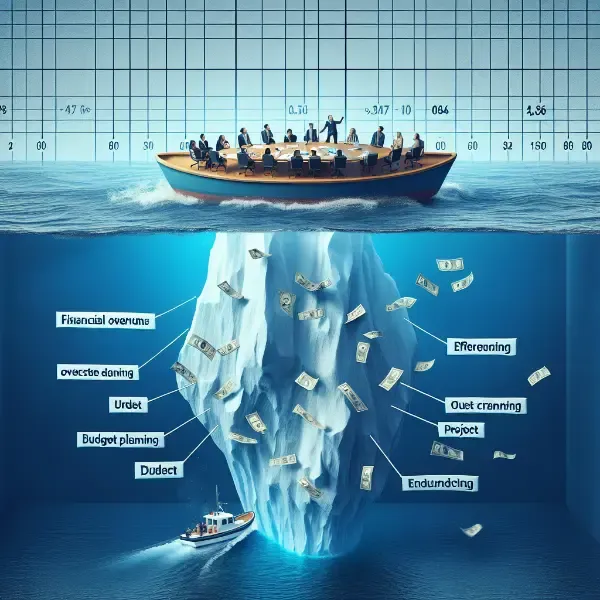
The budget iceberg: how to avoid overruns
Cost overruns are a classic project killer. The remedy is a realistic budget, transparent spend control and swift course corrections.
Define a detailed cost estimate with a risk buffer. Track costs in real time and report variances. Use metrics such as Earned Value and estimate at completion forecasts. Match the commercial model to the level of scope uncertainty, e.g. Time & Materials vs Fixed Price, consciously balancing predictability and flexibility. Early financial visibility helps prevent disaster.
The silent storm: poor communication
Poor communication is an invisible storm that wrecks collaboration and the timeline. Misunderstandings create conflict and decisions based on assumptions.

Set a communication plan: who communicates what, how, how often and through which channels. Create a single source of truth for requirements, decisions and statuses. Document arrangements and maintain a decision log. Support the team with real-time collaboration tools so everyone stays on the same page. Good practices, widely described for example by ProProfs, genuinely reduce the risk of misunderstandings.
A well-aligned crew: how to avoid team disharmony
A lack of trust and blurred roles lower morale and slow delivery. A team needs a shared direction and clear rules of collaboration.
Develop a team charter and clarify roles and responsibilities, for example through RACI. Build a culture of feedback, retrospectives and transparency. Invest in onboarding, mentoring and opportunities for collaboration, such as pair programming and code review. Balance personalities and strengths, and connect team goals with business goals, for example through OKR. Practices promoted by Leaware help maintain alignment around value for the user.
Mastering resource allocation
Underestimated capacity and bottlenecks can paralyse progress. Effective resource planning is essential for on-time delivery without sacrificing quality.
Map the team's skills and availability, and use capacity planning and resource levelling. Set limits on concurrent tasks to avoid fragmentation. Use tools to visualise workload and workflow. Consider buffers on the critical path and cross-skilling to reduce dependencies. Good practices from analytics and product work, described for instance in the context of Mixpanel, highlight the importance of conscious, data-driven decisions.
Sailing through competing priorities
Parallel initiatives and urgent stakeholder requests can easily break focus. Without a coherent priority hierarchy, a project quickly loses momentum.
Introduce a transparent prioritisation framework, such as MoSCoW or WSJF, and link it to strategic goals and OKR. Limit WIP, maintain a portfolio Kanban, and enforce a regular cycle of planning, reviews and decision-driven re-prioritisation. Define escalation mechanisms and criteria for when something goes onto the roadmap and when it goes into the parking lot. This helps the team stay focused on the highest-value work.
Summary: three rules of navigation
- A clear goal, measurable milestones and one shared map of reality for the entire team
- Discipline in managing scope, budget and change, based on data and transparent decisions
- A culture of communication, trust and accountability that strengthens collaboration and delivery pace
Need technology support?
Let’s talk about your project — from discovery to implementation.
Book a consultationWould you like to know more?
Explore other articles or let’s discuss your project
All articles Let’s design your AI application